Agriculture
Canola Meal Supply, Sourcing and Bulk Procurement
How animal-feed buyers can define, evaluate and source canola meal without relying on an ambiguous product name or assumed nutrient values.
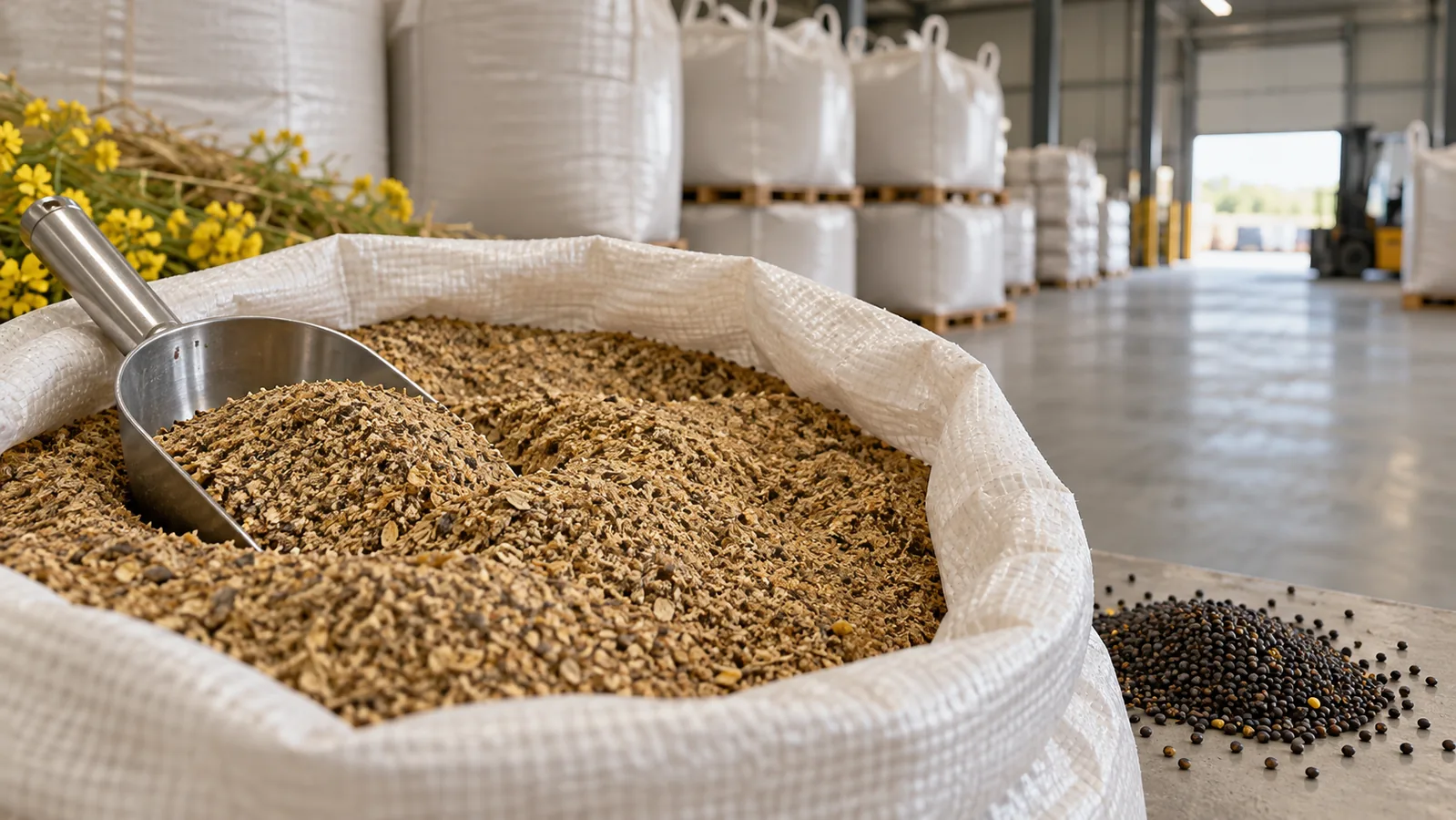
Table of Contents
Canola meal is the solid material processed after oil is extracted from canola seed, and it is traded primarily as a protein-bearing ingredient for animal feed. Bulk buyers should procure it as canola meal, not assume that “canola powder” describes a standard grade, and confirm the processing method, current analysis, physical form and feed-safety requirements for the actual lot.
Some buyers may use “canola powder” informally for finely ground meal, but that wording does not establish composition or suitability. A commercially useful RFQ should name canola meal and describe any required grind or particle-size profile separately.
What Is Canola Meal?
Canola meal is the oilseed meal remaining after most of the oil has been removed from canola seed. The Canola Council of Canada describes it as the processed solid co-product of canola oil production and a protein source used in animal feed.
Its properties depend on the seed, hull content, extraction method, heat treatment, residual oil, grinding and storage. “Meal” is therefore the correct commercial starting point, but the buyer still needs a contract specification. The terms canola meal, rapeseed meal and canola-quality rapeseed meal may also be handled differently across markets and standards.
How Is Canola Meal Produced?
Canola seed is cleaned and prepared before oil extraction. In a common pre-press solvent process, the seed is conditioned, flaked, cooked and pressed; remaining oil is then extracted, and the solid material is desolventized, toasted, dried, cooled and granulated.
Mechanical or expeller processing omits solvent extraction and can leave a different residual-oil profile. Processing temperature and time also influence product quality. Buyers should ask whether the offer is solvent-extracted, expeller-pressed or produced by another method and should approve the resulting analysis rather than infer it.
Canola Meal vs Canola Oil
Canola oil is the liquid oil fraction; canola meal is the processed solid fraction remaining after extraction. They serve different buyers, specifications and logistics systems.
| Feature | Canola oil | Canola meal |
|---|---|---|
| Commercial form | Liquid vegetable oil | Dry meal, mash, granules or pellets as specified |
| Primary market | Food, further processing and approved industrial uses | Animal-feed manufacture and formulated rations |
| Key buying focus | Grade, refining status, identity, oxidation and food-safety criteria | Nutrient analysis, processing method, physical form and feed safety |
| Handling | Food-grade containers, tanks or tanker systems | Bags, bulk bags or dry-bulk systems |
Buyers seeking the oil fraction should use the separate guide to bulk canola oil supply and sourcing.
What Is Canola Meal Used For?
Canola meal is used mainly as a feed ingredient in professionally formulated diets. Feed manufacturers and nutritionists evaluate it as one component of a complete ration, not as a finished feed or a universally interchangeable protein source.
The target species, life stage, inclusion rate, other ingredients and current laboratory results all matter. Claims about performance or a fixed nutrient contribution should not be transferred from a general reference to a commercial lot without formulation review.
Canola Meal in Animal Feed
Canola meal is used in feeds for livestock, poultry and aquaculture where a qualified formulator determines that it fits the ration. Commercial acceptance depends on nutrient availability, consistency, processing quality, physical handling and delivered value relative to alternative ingredients.
Feed buyers should establish approval criteria with an animal nutritionist and quality team. They may require testing for protein, moisture, residual oil, fibre, ash, heat-treatment indicators, glucosinolates, microbiological quality, mycotoxins, residues or other parameters based on species, regulation and risk assessment. This list is not a universal specification.
Who Buys Canola Meal in Bulk?
Typical buyers include compound-feed manufacturers, premix and concentrate producers, integrated livestock businesses, aquafeed companies, large farms with professional formulation systems, commodity traders and importers serving the feed sector.
Some buyers need consistent recurring deliveries; others procure opportunistically when analysis and delivered value fit a formulation. In both cases, the end user's technical approval should precede contracting.
Important Canola Meal Specifications
A current supplier specification and lot-specific certificate of analysis, where required, are more useful than an online “typical value.” Nutrient figures vary with raw material and processing, so this guide deliberately does not present them as Duara Group guarantees.
| Specification area | Questions for the buyer or supplier |
|---|---|
| Identity and process | Is it canola meal? Was it solvent-extracted, expeller-pressed or otherwise processed? |
| Nutrient analysis | Which protein, moisture, oil, fibre, ash and energy-related values are required, and on what basis? |
| Processing quality | Which heat-treatment or protein-quality indicators must be reported? |
| Feed safety | Which microbiological, mycotoxin, residue, contaminant or prohibited-material checks apply? |
| Physical properties | Is meal, mash, granulated or pelleted material required? Are particle size and flowability specified? |
| Traceability | What lot identification, origin, facility and chain-of-custody information is mandatory? |
Packaging and Bulk Supply
Canola meal may move in bags, bulk bags or dry-bulk systems depending on the source, order size, route and receiving facility. Actual formats and unit weights must be confirmed for the proposed supplier rather than assumed.
Packaging should protect the meal from water, pests, contamination and loss while remaining compatible with unloading and storage. Buyers should state bag or bulk preference, liner needs, labels, palletisation, lot coding, seals and any container-cleanliness or previous-cargo restrictions.
Sourcing Canola Meal
Sourcing begins with the end user's formulation and intake requirements. The procurement team should define acceptable processing methods, analytical limits, test methods, sample approval, lot size, shipment schedule and rules for out-of-specification results.
Duara Group can review canola meal sourcing requirements for African and international buyers subject to source, specification and route confirmation. For related product and application context, visit the canola and edible oils product page, the animal-feed supplies page or the agricultural commodities category.
International Procurement and Export
Cross-border canola meal procurement requires alignment between product classification, feed regulation, import permits, sanitary or phytosanitary controls where applicable, inspection, fumigation rules, origin documentation and the buyer's quality programme.
Transport planning should consider moisture protection, container condition, ventilation strategy where appropriate, port time, sampling access and the receiving site's unloading capacity. The quotation should state the Incoterm with named place and identify which party handles export clearance, import clearance, insurance and destination charges.
What Buyers Should Include in an RFQ
A canola meal RFQ should be detailed enough for suppliers to offer a technically comparable product.
- Intended animal species, feed application and end-user approval needs
- Required processing method and physical form
- Complete analytical specification, reporting basis and test methods
- Required quantity, shipment size and delivery schedule
- Bag, bulk-bag or dry-bulk preference and labelling requirements
- Destination country, port or inland delivery point
- Requested Incoterm and named place
- Required certificate of analysis, origin, inspection and regulatory documents
- Sampling, rejection and independent-testing requirements
- Quotation currency and payment requirements for discussion
If the request currently says only “canola powder,” add the intended use, process and particle-size requirement so suppliers can determine whether canola meal is the correct product.
Factors Affecting Canola Meal Prices
Canola meal prices are influenced by oilseed crushing economics, meal supply and feed demand, competing protein ingredients, the processing method, analytical quality, quantity, packaging, freight, exchange rates, inspection and destination charges.
Procurement comparisons should use delivered value, not price per tonne alone. Moisture basis, usable nutrients, handling losses, storage, shipment size and formulation constraints can change the economic result. Any quotation is time-bound and should state its specification and delivery basis.
Frequently Asked Questions
What is canola meal?
Canola meal is the processed solid material left after most oil is extracted from canola seed. It is traded mainly as an ingredient for animal-feed manufacture.
Is canola meal the same as canola powder?
Not necessarily. “Canola meal” is the established commodity term. “Canola powder” may be informal wording for a finer material, but it does not identify a recognized specification; buyers should define the exact product and particle size.
Is canola meal used in animal feed?
Yes. Feed manufacturers use canola meal in professionally formulated diets when its analysis and processing quality meet the nutritionist's and buyer's requirements.
Where can I source canola meal in bulk?
Contact an approved oilseed processor, feed-ingredient distributor or sourcing company with a complete specification, quantity and destination. Duara Group can assess sourcing requests subject to supplier and route availability.
How is canola meal transported?
It can move in commercial bags, bulk bags or dry-bulk transport, depending on the supplier and route. The format should match the receiving site's equipment and moisture-control needs.
What specifications should buyers check?
Confirm product identity, extraction process, nutrient analysis, moisture, residual oil, fibre, ash, relevant heat-treatment indicators, feed-safety criteria and physical form. Exact limits must come from the end user's approved specification.
Sources and Further Reading
Source with Duara Group
Need to source canola meal for a feed or processing requirement? Send Duara Group the intended use, specification, quantity, packaging, destination and delivery terms for review.
Follow Duara Group insights on Google
Related articles
Agriculture
Soya Powder Supply, Sourcing and Bulk Procurement
How buyers can define the exact soybean-derived powder or meal they need before asking suppliers to quote.
Agriculture
Rice Polish: Uses, Quality and Bulk Supply for Animal Feed
A practical buyer's guide to rice polish, from milling and feed use to quality, storage, packaging and commercial sourcing.
Agriculture
Sunflower Seeds: Types, Uses and Commercial Supply
Oilseed sunflower and confectionery sunflower serve different markets. This guide explains how commercial buyers specify the right seed for processing or food use.